


What we lose when we detach immigration from racial justice
Dr. Gerardo Martí – March 03, 2026 (re-printed with permission)
Immigration is one of the most morally charged and politically weaponized issues of our time. Christians are told, often in the same breath, to “welcome the stranger” and to “respect the rule of law.” For many believers — especially those trying to raise children or teach young people in classrooms shaped by fear, division, and racial tension — the question feels unavoidable: What does a distinctly Christian perspective on immigration actually demand? Is it simply kindness within existing systems, or does faith require confronting the deeper injustices embedded in those systems themselves?
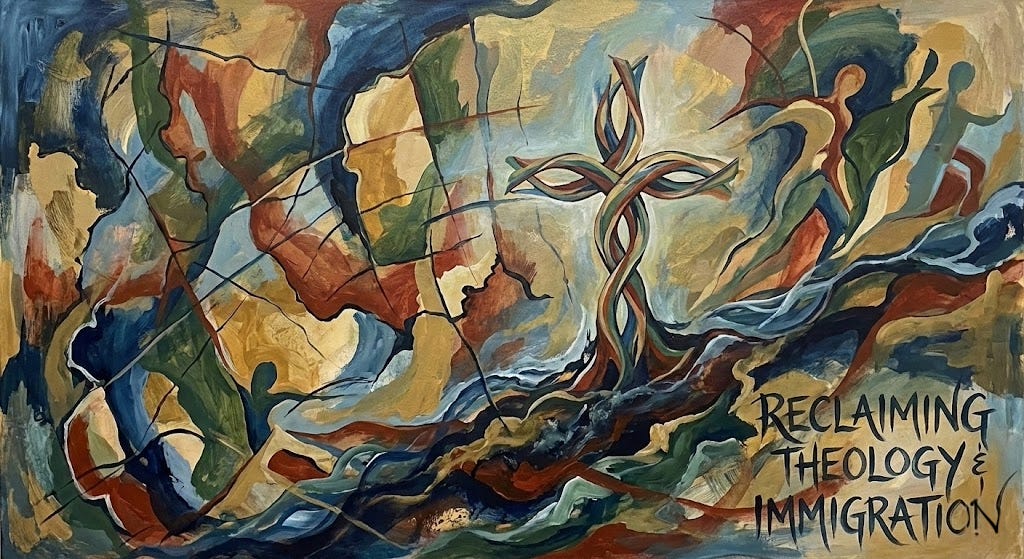
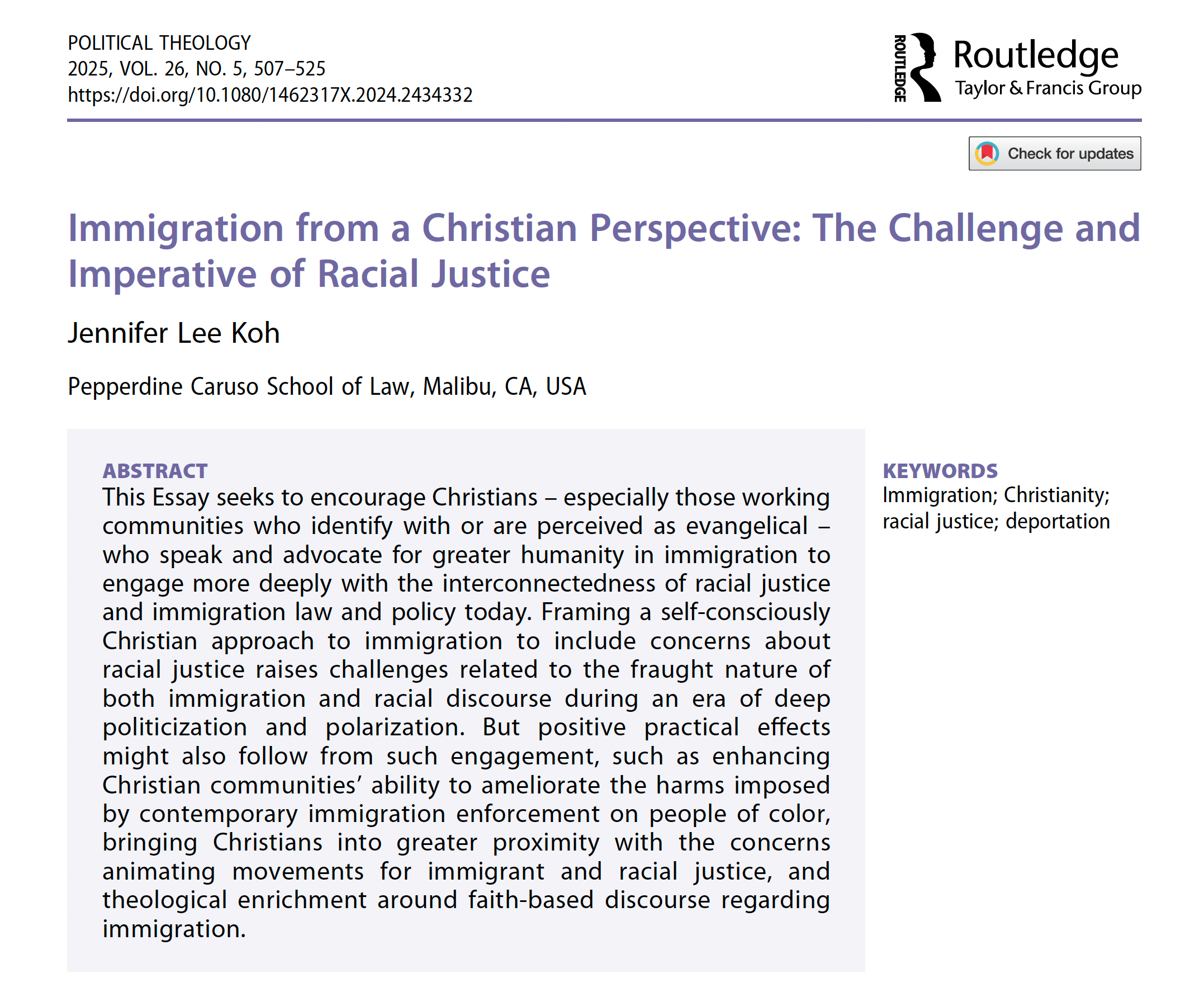
These questions lie at the heart of a recent essay by Jennifer Lee Koh, titled “Immigration from a Christian Perspective: The Challenge and Imperative of Racial Justice.” The article appears in the journal Political Theology in a newly published special issue on Law, Christianity, and Racial Justice and grows out of Koh’s work as a legal scholar at Pepperdine Caruso School of Law. Writing to Christians—especially evangelical audiences—Koh makes a clear and bracing argument: Christian approaches to immigration have emphasized compassion and humanity, but they have too often avoided the hard work of grappling with racial justice. That avoidance, she argues, weakens Christian witness and distorts moral truth.
Let’s take a closer look at key points from Koh’s essay.
The Trap of “Race-Neutral” Compassion
Koh begins by recognizing what many faith-based immigration advocates have accomplished. Over the last decade, Christian leaders and organizations have worked tirelessly to humanize immigrants in public discourse. They have drawn on Scripture’s repeated commands to care for the vulnerable, the doctrine of the Imago Dei (that all people are made in God’s image), and biblical migration stories—from Abraham to the flight of Mary, Joseph, and Jesus. These efforts have helped many Christians see immigrants not as abstractions but as neighbors, families, and fellow believers.
Yet Koh observes a troubling pattern: mainstream Christian immigration advocacy has largely framed the issue in race-neutral terms. It focuses on softer issues like family unity, refugee resettlement, and legal pathways to status, while steering clear of the most racially charged aspects of the system—detention, deportation, criminalization, and border enforcement. As she puts it, Christian advocacy has become “moderate, limited, and disengaged from racial justice concerns.”
This is not accidental. Koh carefully names the pressures shaping Christian discourse. Surveys consistently show that White evangelicals remain among the most restrictionist groups on immigration in the United States. One reason is that Christian nationalism has cast immigration as a threat to cultural identity. Within many churches, just the mention of race or immigration risks accusations of being “political” or aligned with movements like critical race theory. Under this ethos, Christian churches and non-profit organizations often pursue what seems “winnable,” avoiding language or positions that might fracture their base of donors and volunteers.
But Koh insists that this strategic caution comes at a high moral cost.
The Intrinsic Link Between Immigration and Race
First, Koh shows that the harshest parts of the immigration system overwhelmingly harm people of color. Detention centers, family separation, and border enforcement practices have normalized suffering that would likely be intolerable if victims were white. “The fact that black and brown people have borne the brunt of the human suffering associated with immigration policy,” she writes, “invokes a complex set of factors that extend beyond mere racism.”
Second, Koh traces how immigration law has historically been focused on racial exclusion—from Chinese exclusion laws to national-origin quotas and contemporary criminalization of migration. Even when laws are framed as neutral, race shapes who is seen as dangerous, foreign, or undeserving. Immigration status is now a proxy for race, reinforcing broader hierarchies of equality and belonging.
Third, she highlights how the lack of accountability in immigration enforcement allow racialized practices to flourish. From racial profiling at the border to abusive detention conditions, the system operates with minimal transparency. Koh reminds readers that the Supreme Court has explicitly tolerated racial profiling in immigration enforcement — something unimaginable in many other areas of law.
What, then, is lost when Christians avoid racial justice in immigration?
The Cost of Avoidance
Koh names several losses. One is truth itself. Christians committed to seeking truth cannot fully understand immigration without facing how race structures it. Another loss is moral clarity: when churches focus only on “nice” immigrants—refugees, children, or families without criminal records — they avoid wrestling with Jesus’ call to stand with the least and most stigmatized. A third loss is relationship. By distancing themselves from immigrant justice movements led by people of color, Christians miss opportunities for learning, partnership, and witness.
Here Koh turns explicitly to Martin Luther King Jr. as both inspiration and warning. She recalls in A Letter from a Birmingham Jail his rebuke of white moderates who preferred order over justice and who supported civil rights in theory but not in practice. Quoting King, she writes:
“The contemporary church is often a weak, ineffectual voice with an uncertain sound… Far from being disturbed by the presence of the church, the power structure of the average community is consoled by the church’s silent and often vocal sanction of things as they are.”
For Koh as well as for King, a faith that refuses to confront racial injustice risks becoming a chaplain serving the status quo rather than a witness to God’s justice.

Koh insists that Christian theology already contains the resources needed for deeper engagement. The doctrines that animate Christian compassion for immigrants — Imago Dei, agape love, grace, redemption, and the biblical command to remember those “in chains” — also demand attention to the systems that consistently wound particular communities. “If the Christian faith does not present an obstacle to engaging more deeply with racial injustice in immigration law,” she writes, “then an honest assessment of the law, policy and practice side of immigration should compel Christians to speak more boldly.”
Racial Justice is More Than an “Add-On” to Christian Faith
Racial justice is not an add-on to Christian concern for immigrants; it is intrinsic to understanding who suffers and why.
Koh names what might be gained if Christians take this step. Rather than focusing only on the congregational politics of legislative reform or charitable contributions that support humanitarian relief, churches might engage detention, deportation, and accountability for abuse. They might support bond funds, accompany families facing removal, or challenge policies that criminalize entire communities. Second, Christians could enter into partnerships with organizations dedicated to immigrant justice, often led by people of color—learning from their wisdom, pain, and courage. Many already draw on spiritual resources such as hope, sacrifice, and nonviolent resistance, echoing the legacy of the civil rights movement.
Here Koh again invokes Martin Luther King Jr., not as a symbol of comfort but as a model of costly faith. King did not avoid conflict; he engaged movements he did not fully agree with, including Black Power, while affirming the justice of their underlying grievances. Koh suggests that today’s Christians face a similar choice: retreat into “safe” compassion or step into the harder work of solidarity.
Her most concrete example is the work of Guerline Jozef, founder of the Haitian Bridge Alliance, who openly connects her Christian faith to her advocacy for Black migrants. Jozef draws on biblical stories of Moses and Harriet Tubman and regularly cites Hebrews 13:3: “Remember those in prison as if you were together with them.” Jozef is an example of what a racially conscious Christian approach to immigration can look like: rooted in faith, fearless in naming injustice, and deeply engaged with those who suffer most.
A Distinctly Christian Perspective
Koh’s argument is hopeful. She does not call Christians to abandon their theological language or spiritual practices. She calls them to deepen them. She acknowledges that engaging racial justice will create tension — within churches and among believers themselves. Some will fear losing influence or being labeled radical. Yet Koh reminds readers that the Christian tradition is filled with people like King himself who was surveilled, imprisoned, and ultimately killed.
A distinctly Christian perspective on immigration, Koh argues, cannot stop at welcoming language or selective mercy. It must reckon with the reality that immigration policy has become one of the primary ways racial hierarchy is enforced in the modern United States. To ignore that reality is to misunderstand both immigration and the gospel.
Because Christians are individuals influenced by the social world around them, there will be Christians who hold varying attitudes toward immigration. Many express their attitudes on the basis of their “being a Christian” — whether from the pulpit or pew, on social media or in conversation — as if that alone makes their attitude a properly “Christian” one. A pervasive Christian argument for strict immigration and strong national borders centers on posing a biblical mandate for the rule of law, which draws out the notion of a God-ordained nature of sovereign nations. Complex passages, like Romans 13, are used to emphasize that God instituted civil governments to maintain order, uphold justice, and protect their own citizens — even though a history of Christian resistance to oppressive governments throughout the centuries complicate a simple reading of this text. Also, the biblical account of Nehemiah rebuilding the walls of Jerusalem is viewed as precedent for national security and necessary borders, with generous immigration policies being seen as promoting disorder and lawlessness. Even stewardship is often invoked, suggesting that a nation’s leaders have a divine duty — much like a biblical head of household — to prioritize the safety, economic stability, and resources of their own citizens first, which ignores the distinctive modern governance of branches of government, protections against abuse of power, and the multiple interests inherent to large issues like immigration. I’m sure Koh is well aware of many such “biblical” arguments.
For those who become aware of racial injustice — especially those who shape the moral imagination of students and children every day — Koh’s essay offers a crucial reminder: what we teach about immigrants also teaches something about whose lives deserve attention, whose pain is visible, and whose stories count as valid. If Christian faith is to be more than a source of comfort and encouragement, and if such a faith refuses to be blind to how racialized restrictions have always guided our policies of citizenship and national belonging, then that faith must become a lens for seeing the suffering caused by enforcing immigration laws and grasping the consequences of radical shifts in policy when they are guided more by stigma than by measured governance.
In the end, Koh’s essay asserts that any Christian approach to immigration worthy of the name will not only “welcome the stranger.” It will also name the forces that make some strangers perpetually unwelcome. And in doing so, it may recover a faith that is not merely kind to strangers, but courageous, capable of standing with those most wounded by law and most forgotten by society, and of proclaiming, in word and deed, that justice and mercy belong together.


Join our LEARN Community to access Dr. Marti’s seminars American Blindspot Book Talk and American Legacies of Oppression.
Connect with Dr. Gerardo Martí
Gerardo Martí on Substack: American Blindspot: Race, Religion, Power, and Social Change
Gerardo Martí on Bluesky
Resources
Immigration from a Christian Perspective: The Challenge and Imperative of Racial Justice
Letter from a Birmingham Jail [King, Jr.]
The New Immigration Crackdown: Where Americans Stand – PRRI
(PDF) The Changing Church and the Challenge of Racial Justice
Recent Comments